
There is a specific kind of dread that sets in for Westchester drivers when the humidity hits 90% and you realize your car’s air conditioning is blowing lukewarm air. Whether you’re stuck in traffic on Route 9 or heading out for a weekend in the Hudson Valley, a failing AC isn’t just an inconvenience: it’s a safety hazard that can lead to driver fatigue and frayed tempers.
At Mickey’s Automotive, Inc., we’ve been helping our neighbors stay cool since 1980. With over 45 years of combined experience, our ASE-certified technicians have seen every possible AC failure. Most of the time, these expensive repairs could have been avoided by steering clear of a few common mistakes.
If your vents aren’t delivering that crisp, mountain-air chill, you might be making one of these seven common errors. Here is how to spot them and, more importantly, how to fix them before the next heatwave hits Sleepy Hollow.
1. The “Wait and See” Approach to Weak Cooling
The most common mistake drivers make is ignoring the early warning signs. You might notice that it takes ten minutes for the car to get comfortable instead of two, or that the air is “cool-ish” but never truly cold.
Many people assume this is just a side effect of a hot day. In reality, an AC system that isn’t performing at 100% is often struggling with low refrigerant or a small leak. When the system is low on refrigerant, the compressor has to work twice as hard to move heat out of the cabin. This leads to premature wear and tear on expensive components.
The Fix: Don’t wait for the system to stop blowing air entirely. If you notice a drop in performance, bring it in for a professional pressure test. Catching a small leak early can save you from a total compressor failure down the road.
2. Neglecting the Cabin Air Filter
Think of your cabin air filter like the lungs of your vehicle’s HVAC system. Its job is to trap dust, pollen, and Westchester allergens before they enter your lungs. Over time, this filter becomes a wall of debris.
When the filter is clogged, it chokes the airflow. Your blower motor has to work harder, and the air coming out of the vents feels weak even if the AC system itself is working perfectly. A dirty filter can also trap moisture, leading to that unpleasant “dirty gym sock” smell every time you turn on the air.
The Fix: Check your owner’s manual for the recommended interval, but generally, we suggest a replacement every 12,000 to 15,000 miles. If you frequently drive in dusty areas or heavy traffic, you may need to swap it out even sooner.
3. Ignoring the “Front-End Blockade”
Your car’s AC system relies on a component called the condenser, which is usually located right in front of the radiator. Its job is to release the heat absorbed from your cabin into the outside air.
Because of its location behind the front grille, it acts like a magnet for leaves, plastic bags, and highway bugs. If the condenser is blocked by debris, it can’t shed heat. This results in the AC blowing cold air while you’re moving but turning warm as soon as you stop at a red light in Sleepy Hollow.
The Fix: During your regular car maintenance services, ask your technician to inspect the condenser for blockages or bent fins. A gentle cleaning of the front grille area can often restore a significant amount of cooling power.
4. Falling for the “Can-in-a-Box” DIY Recharge Kits
We see this mistake every summer. A driver buys a DIY recharge kit from a big-box store, hooks it up to the low-pressure side, and pulls the trigger. While these kits are marketed as an easy fix, they can be incredibly dangerous for your car’s health.
Automotive AC systems are precision-engineered. They require a very specific amount of refrigerant: measured in ounces, not “until the needle is in the green.” Overfilling the system is just as bad as underfilling it; it can cause “slugging,” where liquid refrigerant enters the compressor and destroys it instantly. Furthermore, these kits often contain “stop-leak” additives that can gum up professional recovery machines and clog internal orifices.
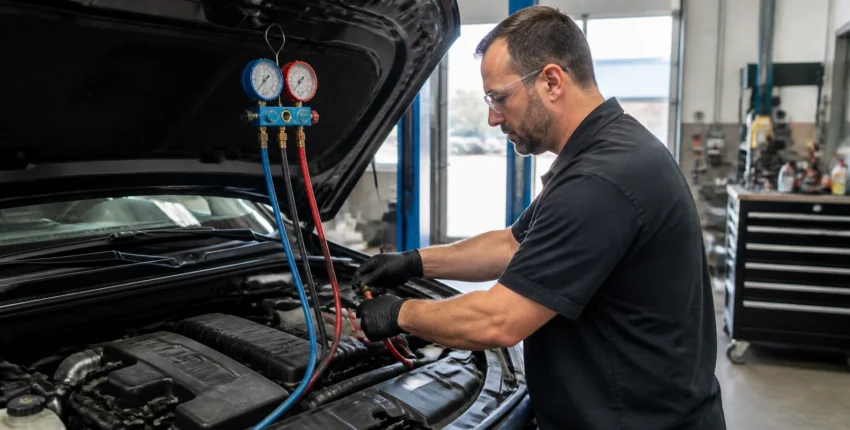
The Fix: Proper air conditioning repair Sleepy Hollow requires a vacuum pump and a manifold gauge set to ensure the system is moisture-free and filled to exact factory specifications. Always leave the refrigerant handling to an ASE certified auto repair specialist.

5. Mismanaging the Recirculate Button
The “Recirculate” button (the one with the U-turn arrow inside a car silhouette) is often misunderstood. Many drivers leave it off, forcing the AC to constantly pull in 95-degree air from outside and try to cool it down to 60 degrees. This puts a massive load on the system.
However, if you get into a car that has been sitting in the sun, turning on “Recirculate” immediately is also a mistake. You’ll just be recirculating the 130-degree air trapped inside the cabin.
The Fix: When you first get into a hot car, roll down the windows and run the AC on “Fresh Air” mode for a minute or two to push the hottest air out. Once the interior temperature matches the outside air, roll up the windows and switch to “Recirculate.” This allows the AC to cool already-cooled air, making it much more efficient and easier on your engine.
6. Overlooking Musty Odors and Damp Carpets
If your car smells like a basement, or if you notice the passenger-side floor mat feels damp, you aren’t just dealing with a comfort issue: you have a drainage problem.
The AC evaporator produces a lot of condensation (that’s why you see a puddle under your car after parking). This water is supposed to exit through a small drain tube. If that tube gets clogged with dust or mold, the water backs up into the HVAC housing and eventually spills onto your carpet. This creates a breeding ground for mold and bacteria that can circulate through your vents.
The Fix: If you notice a musty smell or wet floors, have a technician clear the AC drain line. We can also perform an evaporator service to kill the bacteria and mold colonies, ensuring the air you breathe is clean and safe.
7. Skipping the Professional Pre-Summer Inspection
Many drivers treat their car’s AC as a “fix it when it breaks” system. However, the AC system is integrated with your vehicle’s cooling system. A failing AC fan could be a sign that your engine is also at risk of overheating.
A professional inspection isn’t just about blowing cold air; it’s about checking the health of the drive belts, the cooling fans, and the electrical connectors that keep the whole system synchronized.
The Fix: Make an AC checkup part of your annual spring or early summer auto repair Sleepy Hollow routine. A quick inspection by a pro can identify a fraying belt or a leaking seal before it turns into a $1,500 repair bill in the middle of July.
Trust the Experts at Mickey’s Automotive
Since 1980, Mickey’s Automotive, Inc. has been the go-to shop for Westchester families who value honesty and expertise. As a proud NAPA AutoCare Center with ASE-certified technicians, we provide dealership-level diagnostics with the personal touch of a family-owned business.
We don’t just “top off” your AC; we diagnose the root cause of the problem to ensure you stay cool all summer long. From Hunter Wheel Alignments to NY State Inspections and advanced AC diagnostics, we are here to keep your vehicle running safely and smoothly.
Don’t let the summer heat get the best of you. If your AC is making strange noises, smelling funny, or just not keeping up with the Westchester humidity, give us a call or stop by our shop. We’ll give you a straight answer and an upfront price, just like we have for the last 45 years.
Ready to beat the heat? Schedule your AC inspection at Mickey’s Automotive today and enjoy a cooler, more comfortable drive.